A clash screenshot can identify a problem without giving anyone enough information to resolve it. The next person needs the relevant models, the issue location, a clear question and an owner for the decision.
BIM coordination reporting should support that work from finding to checked closure. The value of a report lies in whether the project team can act on its issues and understand their status. A large clash count, by itself, cannot explain what remains unresolved or what a closed item actually proves.
Separate a detected intersection from a coordination decision
A software result can indicate that selected objects intersect or breach a configured rule. The team still needs to decide whether that result represents a project issue, how it should be addressed and which party is authorized to make the change.
Autodesk's clash-issue tutorial describes assigning an issue to relevant project members and tracking its resolution. The names of statuses and tools vary by platform. Your reporting arrangement should make the decision and review responsibilities clear regardless of the interface used.
Before issuing a coordination report, identify the test basis. Record the model versions, selection rules, tolerances or clearances used where applicable and the issue date. A later reviewer should be able to understand which information produced the finding.
Make each issue understandable without a meeting replay
An issue title such as “clash 247” leaves too much work to the recipient. Describe the location and the relationship that needs attention. Attach a view that shows enough context to identify the affected objects, together with the specific question to resolve.
An actionable issue record can include the source model references, element identifiers where useful, owner, response date, proposed disposition and current status. Keep those fields proportionate to the project. A smaller team can use a concise register if it preserves the same decision trail.
Use the coordination issue log as a starting point. Its example entries are hypothetical and unscored; they do not describe actual clashes or outcomes on an Arcengine project.
Follow one interface through the issue log
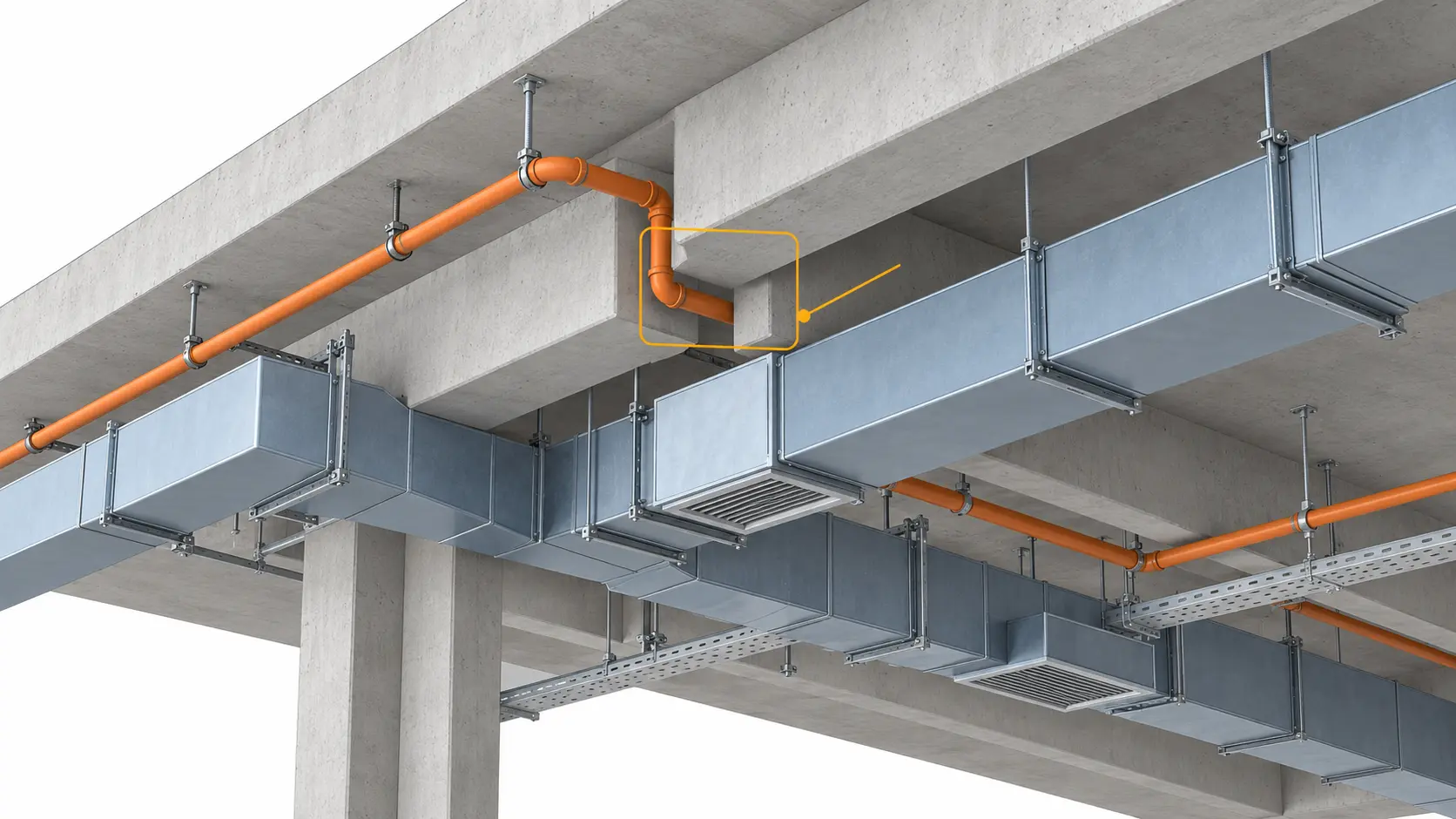
In this illustrative example, a service route passes through the space occupied by a structural element. The report should present the condition and request a coordinated response. It should not direct an unapproved structural or services change.
| Stage | Example record | Evidence retained |
|---|---|---|
| Finding | Service/structure interface needs investigation | Saved view and identified model revisions |
| Assignment | Relevant discipline lead to assess a route proposal | Assigned owner and stated question |
| Decision | Project team records an authorized disposition | Decision reference and affected information |
| Revision | Responsible model author applies the agreed change | Changed model revision and response |
| Check | Agreed review confirms the disposition in the current exchange | Checked view, reviewer and closure basis |
The final check may need more than a new screenshot. If the response creates another interface, clearance or design question, identify that dependency. A result disappearing from one test is not evidence that every relevant project requirement has been satisfied.
Define what each status means
Use statuses that distinguish investigation, an agreed decision, a model revision and a completed check. If the platform provides a fixed status set, explain how your workflow maps to it. Avoid using a single “done” state for several events with different meanings.
Define who can close an issue and what evidence they must inspect. A model author may record that a revision is ready for review. The appointed reviewer can then assess it under the agreed process. The project arrangements determine the roles; this guide does not assign design responsibility through a status field.
Also define when to reopen an issue. A later model revision may reintroduce the condition or invalidate an earlier assumption. Keep the issue history available so that the team can see why the previous closure no longer applies.
Group findings around decisions and ownership
Some raw results may describe the same underlying interface. Grouping can help a discipline lead review one coordinated problem instead of a long list of near-identical screenshots. Retain enough references to show which findings are covered by the group and avoid losing a distinct condition during consolidation.
The report should make open decisions visible by owner and relevant package. Identify which issues affect the next planned issue and which can be addressed later under the agreed project sequence. That is more useful than presenting every finding as equally urgent.
Avoid turning the report into a performance claim. A lower count can result from filtering, changed test rules or grouping, as well as resolved conditions. If the team reports progress, state the counting basis and keep it consistent between reporting periods.
Check the report against the actual exchange
Before sending a report, confirm that its views and references relate to the models being shared. An issue log referencing old files can send a reviewer back to a condition that has already changed. Include a manifest or revision list with the exchange.
At review, keep decisions and required actions connected to the affected issue. If the team agrees a change during a call, record the decision and owner in the working system. Meeting attendance alone is not an issue disposition.
The redline workflow provides a related approach for drawing comments. The drawing-set checklist helps examine outputs affected by the coordinated model change.
Questions about BIM coordination reports
Is a clash-free model guaranteed to be correct?
No. A test examines selected conditions under its configured rules and source information. Design suitability, omitted content and other requirements need the appropriate review. State the test's limits with its results.
What belongs in a closure record?
Retain the issue reference, authorized disposition, changed information, review basis and responsible reviewer. The appropriate detail depends on the project and platform. The record should explain why the issue was closed against a particular exchange.
Can the drafting team decide the fix?
The team can document the condition and develop responses within its agreed authority. Decisions requiring a designer or another responsible specialist should follow the project's review arrangement. Do not infer that authority from who created the issue.
Use the issue log to define your next coordination exchange. If you need support, brief Arcengine's clash-detection team with the model scope, test basis and decision workflow already identified.